

Links HME • Regulated Healthcare Platform Modernization
HIPAA/PCI • Secure workflows • Audit-ready delivery
Modernized regulated workflows without sacrificing auditability
Delivered regulated platform modernization aligned to HIPAA/PCI expectations: secure patient workflow handling, resilient billing operations, role-based access controls, and audit-ready logs—while supporting a large organization and high operational stakes.
Domain: Healthcare
Compliance: HIPAA/PCI
Focus: Workflows + security
Mode: Audit-ready
Security
RBAC+
Role-based permissions and least-privilege patterns.
Audit
Traceable
Event logs tied to workflows and decisions.
Billing
Resilient
Failure-handled workflows and reconciliation thinking.
Delivery
Controlled
Change control, approvals, and deployment discipline.
Security principles
- Least privilege by role and context (who/why/when).
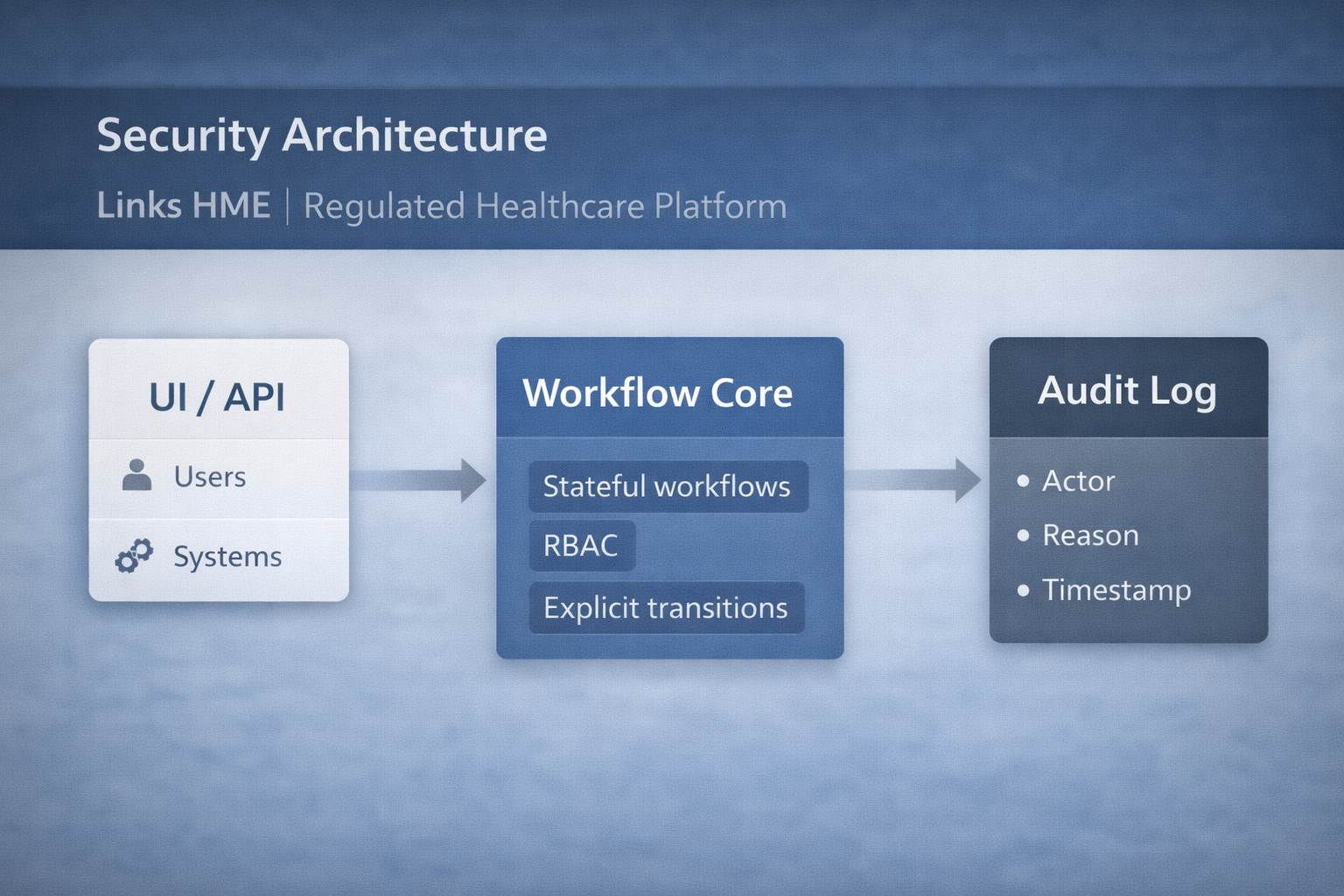
- Audit trail for sensitive actions and workflow transitions.
- Data minimization and controlled exposure in UI/API.
- Secure defaults and explicit approvals for exceptions.
Audit readiness
- Workflow events logged with actor + timestamp + reason.
- Access logs and key actions traceable end-to-end.
- Change control notes tied to deployments/releases.
- Reconciliation reports for billing-related operations.
RBAC table
| Role | Allowed actions | Controls |
|---|---|---|
| Clinician | View/update assigned patient workflow records. | Scoped access + audit log |
| Billing Specialist | Process claims, reconcile payments, issue corrections. | Approval for sensitive adjustments |
| Admin | Manage users/roles, configure workflows. | 2-step confirmation + audit trail |
| Support | Triage issues with limited PHI visibility. | Masked fields + time-limited access |
System map (interactive)
Regulated Workflow Core
Stateful workflows + audit events
Secure API Layer
Integration-ready, privacy-first
Billing + Reconciliation
Integrity + exception handling
Regulated Workflow Core
Delivery approach
1) Risk + compliance mappingPhase 1
Mapped sensitive workflows and defined audit requirements per action.
2) Contract-first designPhase 2
Defined state transitions, RBAC boundaries, and data exposure rules.
3) Controlled rolloutPhase 3
Feature-gated delivery with training, monitoring, and rollback plans.
Impact
| Outcome | What improved |
|---|---|
| Audit confidence | Clear traceability across sensitive workflow actions. |
| Operational resilience | Exception handling reduced “silent” failures. |
| Security posture | Least-privilege access reduced exposure risk. |
| Integration-ready | Secure APIs enabled connectivity without breaking compliance boundaries. |
My leadership
How I led
- Converted compliance requirements into workflow contracts and guardrails.
- Designed for audit trails as a first-class feature, not an afterthought.
- Balanced security, usability, and operational realities for real teams.
Best-practice highlights
- RBAC boundaries and least-privilege defaults
- Explicit workflow states + controlled transitions
- Audit event logging for sensitive actions
- Exception queues + runbooks
© Case Study • Links HME • Regulated Platform Modernization